Total Pageviews

Tuesday, May 11, 2010

Aparna Sen's The Japanese Wife - US Premiere on May 23, 2010

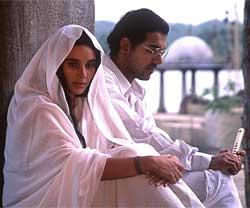
The much awaited film, "The Japanese Wife" directed by award winning director Aparna Sen will premiere in Maryland on May 23rd, 2010.

Databazaar Media Ventures who have acquired the US rights of The Japanese Wife is also planning to screen this film in selected cities all across the US and Canada.

The film will also be screened in Miami on the 22nd and arrangements are being made to screen it in San Fransisco in June.

Bengali organizations , all over the US have stepped up their efforts to ensure that record audiences see this masterpiece by Aparna Sen.

" It has been our endeavor for quite sometime now to create a market for Bengali films in the US," said Oney Seal Founding Director and Chairman of Databazaar Media Ventures, which is the media arm of Databazaar.com, the largest internet retailer of computer consumables. "The Japanese wife is our second release. Our first film was Dwando."

Seal stated that Bengalis and mainstream Americans will have the unique opportunity to watch quality Bengali films (all subtitled in English) at least once a month in the US. DMV is also making the films they acquire, available through 19, 000 retail outlets all across the US, including Netflix, iTunes, Amazon, Blockbuster, Best Buy and Target.

DMV announced that the forthcoming releases are, Ekti Tarar Khonje, Jodi Ek Din and Angshumaner Chhobi.

Tuesday, April 20, 2010

From Institutions to Loving Care at Center for Social Change

Until recently, individuals with developmental disabilities were cattle housed in institutions irrespective of their diagnosis. It was as if, society thought it fit to look the other way by shirking their responsibility and justifying their actions by saying---"What else can we do?"
Horror stories started coming out of these institutions..it started trickling out at first..then the stories came out more regularly. Reports of abuse, led to the understanding that traditionally, signs and symptoms of abuse in people with developmental disabilities were not effectively documented, assessed, or treated. Preconceived ideas like institutionalization, lack of creative communication and technologies, and limited self-determination influenced the commonness of abuse.
Reports of abuse are prevalent in today's society: Pick up a newspaper. Watch the evening news or an afternoon talk show. People agree that abuse must stop. Again, historically individuals with developmental disabilities have been treated with less concern than most people. Studies suggest an increased risk of abuse in persons with developmental disabilities, especially if they have been institutionalized. Abuse ranges from overt physical attacks to more insidious forms of intimidation and neglect.
Emanuel (not his real name) was a 28-year-old man with developmental disabilities, had been in an institutionalized setting all his life. His parents who were aging realized that Emanuel was miserable in this institution and required urgent attention. After research, they approached the State Of Maryland Health and Mental Hygiene for a suitable alternative. After a long wait, Emanuel was taken in by Center for Social Change, a non-profit organization based in Elkridge , Maryland. The center had been in existence for 15 years and had the distinctive reputation of handling such cases.
After a careful read of Emanuel's history and a comprehensive assessment of his functional behavior patterns, a team of in house behavior specialists, psychiatrists and nutritional experts at Center for Social Change put together a plan of tackling Emanuel's problems head on.

The team had immediately discovered that the staff at the institution worked varied schedules and often did not stay with the job long. Emanuel had possibly come in contact with ten or more different staff in a year, making continuity and predictability of meeting his needs and getting to know him a difficult task. Also the multiple bruises on Emanuel's body clearly pointed to the fact that either Emanuel was hurting himself or was a victim of abuse.

" When he (Emanuel) first came to us, we realized that he needed help right away, " said Dr. Joseph Mathew, founder and CEO of Center for Social Change. " He was suffering from mal nutrition, behavior tantrums and mood swings."

Emanuel was housed in a home run by the Center for Social Change in a community setting. He was monitored 24 hours by Center for Social Change direct care staff for Emanuel if left alone could not adequately care for himself. Emanuel had a long history of aggressive behaviors, hitting and kicking people when frustrated. Although he could make several sounds, Emanuel did not form words. Infrequent gestures, some sounds, and changes in his facial expression or behavior gave his direct care staff clues to feelings and thoughts. Individuals with developmental disabilities have varying abilities to communicate; a lack of verbal communication does not equate to a lack of comprehension. Asking Emanuel about his feelings and thoughts gave him an opportunity to try to communicate in another manner about what was happening. Slowly, Emanuel's behavior showed signs of a subtle change. Emanuel was encouraged to help out with household chores, occasionally going to the movies or out to dinner.

A few years later Emanuel was seen rocking back and forth to the music being played during a Christmas celebration at the Center for Social Change, a wide grin on his face. Emanuel had gained weight and his aggressive behavior, almost a rare occurrence.

" Caring for individuals like Emanuel is not easy. We need a lot of patience and understanding. We indoctrinate our direct care staff with these thumb rules and provide them comprehensive training to this effect," informed Dr. Mathew. " Each individual has their own problems...so the treatment and care also has to be individualized. We need to guide them, love them and make them feel wanted and provide them with the requisite tools in order for individuals like Emanuel to become as independent as possible." Dr. Mathew added.

The success of Center for Social Change did not go unnoticed. The Governor of Maryland recently recognized the contribution made by the Center in caring for individuals with developmental disabilities and declared by proclamation November 8, The Center For Social Change Day.

Click here for videos  

Seed Newsvine

Tuesday, April 13, 2010

Nuclear Materials Not Safe in Pakistan

Responding to a question from this journalist on whether the Indian Prime Minister shared the views of President Obama that nuclear materials were safe in Pakistan and in "safe hands,' Dr. Manmohan Singh said, " My position on this issue has been very clear from the start."

Reading between the lines it is quite clear that Dr. Singh does not agree with President Obama on this issue.

President Obama Welcomes India's initiative to Set Up Global Center for Nuclear Energy Partnership

President Obama has welcomed India's initiative on setting up a state of the art Global Center for Nuclear Energy Partnership- a facility based on international participation from IAEA and other interested foreign partners. "We welcome the anoouncement of setting up of this center in India," stated President Obama at the Nuclear Security Summit, after Prime Minister Manmohan Singh announced this initiative by India.

" This will be one more tool to establish best practices ," the president added.

Prime Minister announced the opening of this center during his intervention at the Nuclear Security summit which is being attended by the heads of nearly 47 countries."Singh explained that this center "would consist of four schools dealing with Advanced Nuclear Energy System Studies, Nuclear Security, Radiation Safety and the application of Radioisotopes and Radiation Technology in the areas of health care.

Additionally, "this center will conduct research and development of design systemns that are intrinsically safe, secure, proliferation-resistant and sustainable.

Prime Minister Singh appealed to the global community to participate in this venture to make it a success.

Welcoming President Obama's initiative in convening this summit on Nuclear security, Singh hoped that this summit would lead to "concrete outcomes" which would help male the world a safer place. "The world community should join hands to eliminate the risk of sensitive and valuable materials and technologies falling into the hands opf terrorists and illicit traffickers," said the Indian Prime Minister.

"There should be zero tolerance for individuals and groups which engage in illegal trafficking in nuclear terms," Singh added.

Singh also welcomed the recent agreement betwen the US and Russia to reduce their nuclaer arsenals as " a step to the right direction." " I call upon all states with substantial nuclear arsenals to further accelerate this process by making deeper cuts that will lead to meaningful disarmament."

India asks Canada to Monitor Anti-India terrorist Organzations

Canadian Prime Minister ,Stephen Harper was told to curb the menace of anti -India terrorist activities emanating from his country.

Prime Minister Singh clearly told his Canadian counterpart that he needs to step up and monitor Sikh separatists and their activities in that country.

Briefing to reporters after the meet, the official spokesperson of the Indian external affairs ministry, Vishnu Prakash said, "Manmohan Singh conveyed India's continuing concerns over the activities of terrorist organisations in that country,"

"Manmohan Singh hoped that the Canadian government will curb and monitor the activities of these organizations," said Prakash.

 June 2010  is the 25th Anniversary of the Kanishka Air India bombing.

Outfits like the Babbar Khalsa International, International Sikh Youth Federation, Khalistan Commando Force and Khalistan Zindabad Force continue to be banned under India's Unlawful Activities (Prevention) Amendment Act, 2004.

Sunday, April 11, 2010

India Demands Access to David Headley Coleman?

Meeting in what is being termed as a mini bilateral summit in the sidelines of the Nuclear Security Summit in Washington DC, Prime Minister of India, Dr. Manmohan Singh raised the issue of direct access to David Headley Coleman with President Obama who was reported to have conspired with the banned terrorist organization Lashkar e Taiba and Pakistani ex-military officers to launch the  26/11 Mumbai Blasts in 2008.

Though sympathetic to the demand of the Indian Prime Minister, there is very little that the US president can do. Under the plea bargain agreement which David Headley has reached with the Justice department it clearly has been agreed upon that Headley will not be extradited to India or Pakistan for that matter.

Pressure from the Indian side, though contextually correct and cruicial to the ongoing investigation in demanding access to Headley appears to be a non-starter as Headley could easily plead the 5th and remain silent. It is noteworthy to mention here that India had signed a Mutual Legal Assistance Treaty (MLAT) with the U.S. in 2001 which was further revised in 2005.

The Indian media which is accompanying the Prime Minister on this visit seems almost paranoid on the issue of the Headley case and repeated questions to Foreign Secretary, Nirupma Som was deftly dodged by her.

Saturday, April 10, 2010

Historic First For Bengali Cinema

This is literally Breaking News.

Databazaar Media Ventures(DMV) has succeeded yet again of a coup of sorts. After opening up new vistas in Distribution of quality Bengali films in the US and Canada through 19,000 retail outlets like Netflix, Amazon , Best Buy, Blockbuster and others, DMV can be credited with making available the first Bengali film "Dwando" for rent and download on.iTunes.

DMV, the media arm of Databazaar.com has already acquired the rights of Aparna Sen's The Japanese Wife and will make the film available on iTunes as well.

Friday, April 09, 2010

President Obama to Host Indian PM During Nuclear Summit

The heads of the world's largest and greatest democracies will meet once again in the sidelines of the Nuclear Summit, beginning April 12, 2010.

Dr. ManMohan Singh, India's Prime Minister was initially scheduled to arrive on April 11, but a last minute change in his itinerary will see the Indian PM flying into Andrews Air Force Base on April 10 at 8:45 in the evening.

The change in his itinerary is a clear indication that President Obama will be holding bilateral talks with Singh.The meeting will most likely take place on Sunday.

This meeting is significant as lately there have been reports that the Obama administration has been ignoring India.

According to sources Obama will reiterate his administrations commitment to strategic relations between the US and India.

The White House is very concerned about the close ties India enjoys with Iran. This will prominently figure in the talks when the two leaders meet.However, Iran is not likely to figure in the Nuclear Summit talks as the summit is more about safeguarding Nuclear materials.

It is noteworthy to mention here that India enjoys a great record where non-proliferation of nuclear materials is concerned but refuses to sign the NPT.

According to Deputy National Security Adviser Michael Forman, "Prime Minister Manmohan Singh's attendance will be key to the success of the summit."

Wednesday, April 07, 2010

Databazaar Media Ventures Acquires Aparna Sen's "The Japanese Wife" for US Distribution

Databazaar Media Ventures Acquires Aparna Sen's "The Japanese Wife" for US Distribution

Award winning Director Aparna Sen's latest film "The Japanese Wife" has been acquired for US distribution by Databazaar Media Ventures(DMV).

DMV, the media arm of Databazaar.com , the leading internet retailer of printer consumables globally, acquired the film from Saregama India Limited, the producers of The Japanese Wife.
Expressing satisfaction over this acquisition, Ms. Aparna Sen said, "This is truly a historic occasion. The Indian Diaspora living in the US and Canada will now be able to watch my film as DMV will make The Japanese wife available through about 19,000 retail outlets, including Netflix, Amazon, iTunes, Blockbuster and others."
Talking about The Japanese Wife, Sen said, " Some of you have seen and loved my earlier films…films like ‘36 Chowringhee Lane’ or ‘Mr. and Mrs. Iyer’. This one is different. My challenge here was to create a film that would be reminiscent of a Japanese painting with its poignant minimalism. I think I have succeeded."
Oney Seal, Chairman of the Databazaar Group of companies stated, " Our endeavor is to bring quality Bengali films to the US and Canada. The Japanese Wife directed by the one and only Aparna Sen fits the bill perfectly."
About Databazaar Media Ventures
Databazaar Media Ventures acts as an exclusive gateway for Bengali films to North America, combining the latest in digital technologies with the best in traditional methods in a new, fusion distribution model that maximizes North American film revenues. We are the missing link that ensures the most effective marketing of modern Bengali films. Once selected by DMV’s Film Review Board, exclusive partner agreements ensure that titles acquired will reach over 19,000 online and retail stores across the US and Canada including major chains such as Best Buy, Target, Fry's Electronics, Blockbuster, Netflix, Amazon and Wal-Mart, along with, theatrical releases in certain demographics.

For more information
Contact ray@databazaarmedia.com


NRI Venture Promises New Vistas for Bengali Cinema

NRI Venture Promises New Vistas for Bengali Cinema

Databazaar Media Ventures ( DMV ), the media arm of Databazaar.com, the leading internet supplier of computer consumables based in Florida, USA, has developed an innovative and original model for the screening and distribution of quality Bengali films through more than 19,000 retail outlets in the US and Canada, starting immediately.
Oney Seal, Founder & CEO of the Databazaar Group said, “Our first release -“Dwando”, from national award-winning director Suman Ghosh, is already available for pre-order wherever NRIs buy, rent or download movies ----- on Netflix, Amazon, Best Buy, Target, iTunes, and Blockbuster etc. This is very encouraging and proves beyond doubt that we have implemented a winning business model that fulfils the wishes of both the Bengali film producer as well as the NRI film viewer in North America. Our efforts have also ensured that quality Bengali films will now reach the entire ‘foreign film’ viewing market in North America.”
Arijit Dutta, a founding Director of DMV looking after content & acquisition, expressed satisfaction stating that the revenue gap between production costs and domestic sales, which was plaguing modern Bengali cinema, will now be addressed through the opening up of the North American market.
Suman Ghosh and senior US-Indian journalist Devasish Ray, both founding directors of Databazaar Media Ventures, emphasized the massive reach and scope of the media spend that DMV is investing on each title it acquires. “This is unprecedented and is the critical ingredient for the success of every title”, they added.

About Databazaar Media Ventures
Databazaar Media Ventures acts as an exclusive gateway for Bengali films to North America, combining the latest in digital technologies with the best in traditional methods in a new, fusion distribution model that maximizes North American film revenues. We are the missing link that ensures the most effective marketing of modern Bengali films. Once selected by DMV’s Film Review Board, exclusive partner agreements ensure that titles acquired will reach over 19,000 online and retail stores across the US and Canada including major chains such as Best Buy, Target, Fry's Electronics, Blockbuster, Netflix, Amazon and Wal-Mart, along with, theatrical releases in certain demographics. For more information please visit www.databazaarmedia.com.

Media Contact: Devasish Ray ( USA )- +1-240-988-1112

Saturday, December 15, 2007

Interview with Kapil Sibal

Interview with Kapil Sibal
By Devasish Ray

President Bush has launched his new foreign policy in trying to get Israel and Palestine to talk peace, yet this policy remains a Rubik cube, with some nations attending, curious to see what really transpires. India a long time friend of Palestine and a relatively new playmate of Israel also attended the meet held at Annapolis, the picturesque capital of Maryland, led by a surprise choice, Kapil Sibal, Minister for Science, Technology and Earth Sciences. In his whirlwind tour of the US, Sibal met with both the heads of state of Palestine and Israel and reiterated India’s commitment to play its’ “due role” in assisting this new peace initiative.

Sibal sat down with this correspondent in Washington DC and spoke about his visit, domestic politics, Nandigram, the Nuke Deal, poverty and his reflections on the recent headless chicken fiasco, which forced Ambassador Ronen Sen to apologize in Parliament. Here are some excerpts from this exclusive interview:

DR: You are leading India’s delegation to Annapolis, what are your reflections on this new peace initiative of President Bush?

KS: Well! I think we must congratulate President Bush and also the parties to this conflict, President Mahmoud Abbas and Prime Minister Ehud Olmert for having come together to forge some kind of a road map to the future, with some kind of a time frame, along with a monitoring mechanism as both sides have agreed that US would oversee the progress. They have also agreed to bi-weekly meetings and setting up by December 12 a working group which takes this step further.

DR: It took President Bush seven long years to re initiate this dialogue. What is India’s opinion on this?

KS: As far as I am concerned it is an initiative that must be applauded. You must remember that the crisis in West Asia has been festering for a long time and the impact of the consequences of the conflict have been felt over the world and the International community must come forward to help in any way. We should look upon this initiative with optimism and the issue is not that he took his time. My personal reflection during the course of this summit has been that both parties want peace as they see that violence and negotiations are incompatible. We must encourage and support them.

DR: Yes! India has been a good friend of Palestine and it was the first country to recognize the State of Palestine in1975. Since then there has been a major shift in India’s foreign policy with leanings more towards Israel. Then it was Arafat. Today it is Hamas which is really not keen to talk to Israel. You met President Abbas yesterday. What misgivings did you convey to him?

KS: Everybody including both heads of state knows the obstacles and the pitfalls (meaning Hamas) in the road ahead. Also all know that there are other spoilers besides Hamas. It is going to take a lot of give and take to achieve this peace. This is the impression I got frankly that he really wants peace and has a desire to move forward. Let us see. Again it is imperative that the entire International community come forward in backing this initiative.

DR: There is a reason I asked this question, so let me rephrase it. What is India’s take on Hamas?

KS: You know very well and this is something which we made very clear before too, that violence is not an appropriate route to take when we want to move forward. We have always supported Palestine and its cause and we want good relations with Israel too. I am very happy that the two state concepts have been agreed upon for the very first time.

DR: Switching gears now Kapil… What on earth is going on in Nandigram and why was it allowed to escalate so much?

KS: As far as the central government is concerned we have made our position very clear. The Central government has two takes on this. One, there seem to be evidence of some outside elements who are trying to destabilize this region…

DR: Who are these elements?

KS: I do not want to mention them now?

DR Why?

KS: There is at this moment a temporary resolution so why should anybody make a statement which will increase the tensions in the area. Number two, yes excesses were committed in Nandigram and I am sure the government has taken cognizance of that and we hope that things will improve.

DR: What has your ministry been up to lately?

KS: Quite a lot actually. The bio-tech sector is moving ahead at a pace of 30 to 40 percent. We in collaboration with the ministry of agriculture are working towards a plan to ensure 4 % growth rate. Agriculture needs a lot of technology and we will provide inputs in the quality of soil and seeds. We have new software that monitors crops which alert farmers accordingly. By this we will know the extent of productivity. We are also trying to empower the university structure and are offering scholarships for excellence. We want more students to take to science for which we are offering a Rs 5000 a n incentive. Huge investments are on and the proof of the pudding will be in the eating as it will be evident soon…….

DR: Quite a rosy scenario. How does it percolate down to the common man? Let’s not be defensive about this. We talk of 9 % GDP growth but how has it impacted the poor?

KS: Very important issue that you have raised, Devasish This is the one government which is addressing this issue…….

DR: Come! Come now Kapil! Garibi Hatao has been going on since Mrs. Gandhi. Nothing has been done about this, so do not say that you are doing anything? What concrete steps are you taking…?

KS: I am coming to that. I knew that you would be countering me...

DR: Okay then. Convince me!

KS: I want to inform you that never before in the history of India have you had the kind of investment made in the social sector. They may have been slogans before, but there was no money to back it. That we have a 9% growth is crucial as it gives you the capacity to invest in the social and education sector. Our health budget has increased significantly. There will be a slow impact but there is no magic wand to make it happen immediately.

DR: The nuke deal was botched by your coalition partners? What now?

KS: There are a lot of misgivings but also a lot of politics. We are debating this issue and the opposition which initially had supported this is opposing this for the sake of opposing. I know the Indian American community here has contributed a lot and I must say that we are equally disappointed like the. But, I assure we will move ahead.

DR: Why did the government of India ask one of the finest diplomats Ambassador Ronen Sen to apologize in parliament for a comment he reportedly made off the record? Why did the government subject him to such embarrassment?

KS: Remember Devasish, the parliamentary process is not a governmental process. If the issue is raised in Parliament and the speaker takes note of it and refers it to the privileges committee, the government has no right to override this. So it inappropriate to say that the government allowed this to happen.

It Sounded like a Bullet shot


By Devasish Ray


In a random act of irrational brutality that has shaken the quite neighborhood of the Greencastle area of Silver Spring Maryland; two elderly Sikh gentlemen were beaten up mercilessly by a group of African American teenagers on September 15, 2007

It was cool evening; a slight nip was in the air when Bhupinder Singh Nibber and his brother in law Darshan Singh Sarang decided to take a walk in their picturesque backyard which trails into a small lake surrounded by lush green trees and bushes. Nibber, 75 years old had taken a walk regularly in these safe surroundings regularly. Not that day! For 5 minutes into the walk a group of African American teenagers aged between 14 and 16 years approached them menacingly and punched Sarang, 85, squarely in the eye, knocking him down. As Sarang collapsed to the ground moaning in pain the alleged assailants rained blows on him, kicking him in the ribs and stomach.

As Sarang was loosing consciousness, Nibber completely perplexed, intervened questioning the assailants. “Why are you doing this,” he cried out, reaching for his cell phone. “Do you want me to call the police?”

This infuriated the assailants even more and now they turned their ire on Nibber. “It sounded like a bullet shot,” recalled Nibber, wincing in pain, as a blow landed on his left temple followed by a punch in the ribs and a kick to his head.

As the situation turned from shock to the realization that both of them could be dead in a matter of minutes, they started shouting…Help! Help! They are going to kill us!

Fearing a reprisal from neighbors, the assailants fled leaving the two victims senseless on the ground. As both regained consciousness they gathered themselves and slowly limped to their house. Sudesh, wife of Bhupinder Singh was aghast when she saw her husband at the door. His turban was in his hand and face swollen as he staggered into the house looking for support to stand. Sudesh immediately called the emergency number and police responded within minutes.

The police scouted the area for the assailants and not finding them ascertained that they were not from the neighborhood. Though this incident took place nearly a week ago, the police are clueless. Repeated attempts by this correspondent to solicit some response from the concerned investigating officer have yet to yield results. Phone calls have not been returned till date.

Surveying the neighborhood, this correspondent was surprised to note that the distance from the scene of the crime and the residential houses is only a few yards. That no one heard their cries for help is a bit hard to digest. However, one is yet to determine whether this incident was a hate crime or a teenager’s initiation into a street gang. It is common knowledge that teenagers who join street gangs have to prove themselves by some act of violence.

While Nibber and Sarang come to terms with what happened they are not sure whether it was a hate crime or gang related violence. “I do not know whether they thought that we overheard their conversation or it was plain and simple that I was a turbaned Sikh,” said Nibber. Sarang was too distraught to even talk.

Whatever may the reason be for this senseless act of violence against two elderly Sikhs, it is bewildering that the assailants had no regard for the age of these two victims. The result could have been fatal.

While the Sikh and the Indian American community in the Washington DC metropolitan area is outraged there is little they could do except protest. What is ironical is that the newly elected County Executive Ike Legget lives just 2 miles away from the crime scene.

Subhash Ghai presents NOUKADUBI, the most awaited film of the year. Watch it on Databazaar Media !!

Tuesday, October 03, 2006

General Drive


Subhash Ghai presents NOUKADUBI, the most awaited film of the year. Watch it on Databazaar Media !!

General Drivel

Devashish Ray/Washington

VIEW FROM AMERICA

Most Americans can't make sense of the book.

Using the White House to announce his book and dropping juicy quotes like a public relations junkie, General Pervez Musharraf has proved that he was artful as ever. With the press scrambling to guess what was coming and academics reading between the lines, he ensured that the book was firmly placed in the limelight. Musharraf says, "Most of the people in fact were against my writing this book at this moment, but like a good military leader, I took the decision against the major part of their advice." The man is obviously full of himself.The 335-page book begins with his train journey from New Delhi to Karachi during Partition and goes on to describe how he took over. Musharraf has tried to portray himself as a man who tried and failed to secure a peace accord during the Agra summit. "I met Prime Minister Vajpayee at about 11 O'clock that night in an extremely sombre mood," he writes. "I told him bluntly that there seems to be someone above the two of us who had the power to overrule us. I also said that both of us had been humiliated. He just sat there, speechless. I left abruptly, after thanking him in a brisk manner.""I think the Indian establishment-the bureaucrats, diplomats and intelligence agencies and perhaps even the military-have gotten the better of him. I feel that if a leader is to break away from hackneyed ideas and frozen positions, he has to be bold." Teresita Schaffer, former US ambassador to Sri Lanka and director of the south Asia programme at the Center for Strategic and International Studies in Washington, seems to agree. "I haven't read the book, but the Agra summit did fall through," she says. "I don't think the blame lies on Vajpayee, but perhaps Musharraf's indication is that he was in total control where Pakistan was concerned, and Vajpayee was not." Walter Andersen, director of the south Asia programme at Johns Hopkins, says, "It's not the Indian bureaucrats or intelligence agencies that Musharraf holds accountable. It is L.K. Advani. It was he who practically pressured Vajpayee into not accepting a lasting peace agreement with Pakistan."Faroq Hasanth, Pakistani scholar at the Middle Eastern Institute in Washington, offers another interpretation. "While the insinuation about Advani is probably true, we do not know what the terms of the agreement were," he says. "Musharraf did not do any homework for the Agra summit. I recall the former foreign minister of India Swaran Singh and Pakistan prime minister Z.A. Bhutto meeting several times, not just once like Vajpayee and Musharraf." Schaffer is also concerned over the peace overtures between Pakistan and the resurgent Taliban. "It's not exactly clear what this olive branch is all about; we have to wait and see how it is implemented," she says.In one passage, Musharraf blames India for the Kargil war. "My gosh," says a US state department official. "This guy is unbelievable. Even the hardcore Pakistanis would not believe this." On the issue of proliferation of nuclear technology, too, Musharraf accuses India of copying Pakistani centrifugal designs and making them available internationally. "Ludicrous," says Hasanth. "Pakistan's core military generals have complete control over it and if anyone has proliferated, it is them. Prime Minister Nawaz Sharif was clueless about the Kargil invasion. Let there be no doubt in anyone's mind that Musharraf is lying through his teeth here." Former national security adviser Brajesh Mishra has called the book a pack of lies. Says Andersen: "This book is a rebuff to Nawaz Sharif's book where he clearly accuses Musharraf of being the architect of the Kargil war. However, no one believes Musharraf on this issue. It was he who was, and still is, in complete charge of the military. His military intelligence is flawless." Andersen is surprised that the leader of a country embroiled in problems has written the book. Hasanth finds the book full of conceits. "Musharraf's book is all about himself, his ego and his holier-than-thou persona. It amazes me how he had the gall to write such a book," he says.

Monday, May 08, 2006

Double Jeopardy


Double Jeopardy - Devasish Ray/Washington

CONTROVERSY
Two youth of Indian origin face infamy in the US for vastly different reasons

It’s a scandal that keeps spreading. Kaavya Viswanathan, a 19-year-old sophomore at Harvard University who wrote a book—How Opal Mehta Got Kissed, Got Wild and Got a Life—has already confessed that she "unconsciously plagiarised" from two books of the best selling author Megan McCafferty—Sloppy Firsts and Second Helpings. About 40 passages were found similar or identical in theme or content.
On the heels of this, The New York Times reported similarities between Opal Mehta and Sophie Kinsella’s Can You Keep a Secret? It said the passages in question were short but contained similiar rhymes and descriptions. It is also said that Kaavya had borrowed passages from Salman Rushdie’s Haroun and the Sea of Stories and Meg Cabot’s The Princess Diaries.

Kaavya shot to fame when she was offered half a million dollars by the publisher Little, Brown and Co. and a movie deal by DreamWorks. To top it all, Angelina Jolie showed interest in playing the lead. Kaavya was on cloud nine and was being positioned as the next literary genius from the Indian subcontinent. But after her exposure, DreamWorks has dropped the film plan and the publishers have decided to withdraw the book permanently and cancel the deal for her second work.
Initially, Kaavya had dismissed the charges of plagiarism saying that she had unconsciously internalised McCafferty’s writings and denied any wrongdoing. However, as evidence against her mounted, she acknowledged her pilferage.
Soon after campus reporter David Zhou of the Harvard Crimson broke the story of Kaavya’s literary theft, message boards at Harvard were replete with sardonic comments. "The literary gods have finally come to their senses," wrote one student. Another wrote: "There’s a part of me that likes seeing Harvard sophomores falling on their face when they’re handed half a million dollar book deals."
If Kaavya is guilty of plagiarism, the publishers must be blamed for being reckless in investing half a million dollars on a teenager. But why did they take the risk?
The answer is that the book industry is enamoured of young, beautiful ethnic writers. The increasing domination of a handful of giant publishers and retailers has led to a concentration on titles that will sell in big quantities. Many of those titles, particularly in fiction, are the works of young and glamorous authors.
Having no track record is an author’s advantage, because the sales figures that influence publishing decisions cannot work against you. Another aspect is that publishing at this level is getting very similar to lucrative contracts from film studios. It is no secret that huge sums of money are being gambled to pay for past flops. However, the possibility of future flops from present-day books is inevitable providing cynics with a reliable supply of sour satisfaction.
Steve Ross, vice president of Crown Publishing House which published McCafferty’s novel, lashed out at Kaavya saying, this is nothing less than an act of literary theft. In her defence, Bill Poser argued in Language Log that she could have unconsciously remembered little snatches from another novel. Many people remember comparable portions of songs that they once heard without remembering the rest of the song or who sang it or wrote it.

But as Dr Sangeeta Ray, author and professor, said: "It sounds like a clear case of plagiarism. One is always influenced by writers and books one reads and likes but everyone who has gone through school knows the difference between influence and plagiarism." Students at universities are warned about the dire consequences of plagiarism and so Kaavya must have known the difference.
The problem is compounded here by the "help" she received by the company that helped her package her book, making it, perhaps, a bit difficult to know where she stopped and where they began. In either case, she, as the author, for better or worse, is responsible for the contents.
Shauna Singh Baldwin, Commo-nwealth Award winning author of the book, What the Body Remembers, has no sympathy for Kaavya. Describing Kaavya as a clever young girl with little character, Shauna stated: "She is symptomatic of a larger problem in desi society—the very problem she described in Opal Mehta. She was so anxious to please, so needy of approbation that she would cheat to achieve."
Kaavya’s career as a budding novelist has ended before it even started. As many literary scholars point out, the pressure to succeed and succeed quickly, and the dream of making millions, can make people plagiarise. Probably, Kaavya was unlucky to have been caught. She will have to do some soul-searching and come up with something genuine to silence her critics. She is, after all, only 19 years old.

Another person who would like to silence his critics is Vikram Buddhi, a 34-year-old student who is languishing in jail on charges of posting threatening messages against President George Bush on a Yahoo finance board dedicated to the satellite radio company Sirrus.
Son of Dr Buddhi Kota Subbarao, a naval scientist who was jailed for 20 months on charges of smuggling nuclear secrets but was acquitted in 1993, Vikram is a mathematics prodigy and has been studying applied mathematics at the University of Purdue in Indiana.
Vikram was arrested on April 14 and charged on 11 counts including charges under US Code 871 that deals with threats to the US president and his successor. If proved guilty, he could be sentenced to imprisonment up to 60 years.

On April 26, Vikram pleaded not guilty but has been suspended from the university and sent to an unknown prison in northern Indiana. Meanwhile, John Martin, the court appointed attorney for Vikram, has requested the court to try him under the first amendment of the US constitution as he could never have actually carried out his threat he allegedly made. His family believes that Vikram is innocent and that someone has hacked into his Internet account to post "kill Bush" messages.
Subbarao, currently a senior advocate of the Supreme Court, said Vikram had been studying at the university for the last 10 years. He described Vikram as a quiet person and said he had received the best teaching award from the university.
Thangam Moorthy, a retired high school teacher who had taught Vikram at St Joseph’s High School in Colaba, Mumbai, has written a letter to John Martin.
She said in the letter: "Vikram is a very calm, soft-spoken, intelligent and hardworking boy, who was focused in his studies. I am absolutely certain that he is a victim of misunderstanding and human weakness like jealousy."
Meanwhile, Subbarao has applied for an emergency visa to the US to discuss the case with Martin, who is the only person allowed access to Vikram . The hearing is scheduled for June 26 and it is going to be agonising days for the family.

Saturday, April 01, 2006

The US India Civillian Nuclear Deal

Ray Defends the All Important Civil Nuclear Deal on the Telly Award Winning TV Show
Passion For Truth

Click on Link or copy and paste to address bar

www.passionfortruthtv.com/483.html

Tuesday, January 03, 2006

I Am Not comfortable Dealing With Dictators: Sen George Allen


I am not comfortable dealing with Dictators: Senator George Allen

Senator George Allen, R-Virginia like many of his colleagues in the Senate and Congress are realizing the potential of India and Indian Americans. Recently the Senator from Virginia visited India and was quite impressed by India’s “successful diverse technological growth and leadership.” In an interview with me (the first given to any South Asian journalist), Senator George Allen, who some say is the prime republican candidate for the Presidential election 2008, speaks about India, Indo-US relations and the civilian nuclear issue. Here are some excerpts.

Devasish Ray
Washington DC
January 3, 2006.

DR: Senator, this was your first visit to India. What have learned so far?

GA: There are so many people from India in Virginia and the United States, some have been key supporters in my campaign and so I wanted to visit India. I was very impressed by the number of engineers graduating. The idea of innovation and I do want the US to be the world capital of innovation, and I wanted to see what India was doing and how they were doing it. I spoke with the leaders of the Indian Institute of Technology. I also met with Prime Minister Manmohan Singh in New Delhi, and then we went down to Bangalore, which was simply amazing. I want to learn more about India; the reason is that I feel that the people of India and the US need to be much closer together. India is after all the world’s largest democracy; many languages, many religions, many cultures and India can be a role model for countries that have ethnic, religious and cultural differences.

DR: I believe that before embarking on your trip to India, you had some negative feelings. After this visit has that cloud been lifted?

GA: Actually there had been some isolated incidents of human rights, but I was not overtly bothered, I was really impressed by India and wanted to see it. Prime Minister Singh came here and I attended his address to the Joint Session of Congress, and since we shared similar values, I wanted to strengthen the relationship. What impressed me were the optimism and the tremendous economic growth of India. I thought we have energy problems in the US; India has a more severe problem. India has a long way to go but clearly there is a will and direction.

DR: I am glad you brought up the energy issue. During Prime Minister Singh’s visit, President Bush announced that India would receive civilian nuclear technology from the US. Do you support this as presented by the administration?

GA: Yes I do! India of course will have to meet some commitments too in planning a credible and coherent separation of civilian and military power. Having said that, I saw how awful the air quality was in India, at least in some cities I visited. The fact is that India has to import more energy than we have to. The cleanest method of generating energy is either clean coal technology or nuclear. For India to be able to survive and grow as a country they will have to go nuclear. We need India’s support of not having a gas pipeline from Iran, as we need to keep pressure on that country. The key for India would be to come up with a way so that they are not in violation of the NPT. India has a very good record….

DR: Do you consider India to be a responsible nuclear nation?

GA: Absolutely. Their record has proven itself. They have not shared this technology with other nations unlike some countries in that area.

DR: Senator, will you be accompanying President Bush to India early next year?

GA: Unfortunately no!

DR: What would you like President Bush to achieve from his trip to India?

GA: Two things! In a larger sense continue to build this really positive and constructive relationship between the people of America and India. The President going to India will definitely help, so will the people India who have a positive image of the US, surveys indicate that. It would be good for the Presidency. Secondly, the nuclear issue. Hopefully, by then the government of India will be further along devising a credible plan as to how the civilian and military aspects could be clearly separated. This will help the President because ultimately Congress will have to vote on this. The President cannot go ahead unless the Senate ratifies the bill.

DR: So you don’t think the bill would go through before the President’s visit?

GA: It will be difficult. We will be tied up in January with the Supreme Court vacancy. It would also help if India signed the NPT.

DR: Senator that is not going to happen.

GA: Well! That would help…

DR: Is there any substantial reason for India to sign the NPT?

GA: It is an indication…

DR: Hmm..

GA: It is. There are countries that are willing to sign it

DR: There are also countries that will not sign too…

GA: But then they are not trying to get an exemption from the NPT.

DR: But then India does have an exemplary track record in non-proliferation.

GA: But……

DR: Senator lets not get into semantics…

GA: (Laughing) I understand. Look I want this to happen. But please understand there will others want the same. We are trying to stop North Korea. Your neighbor Pakistan will want the same once India gets it. I can assure you of that. Obviously there was a serious problem with that nuclear engineer from Pakistan (The Senator was referring to Abdul Qadeer Khan).

DR: The grapevine has it that you could probably be the next President of the United States. Will you be running in 2008?

GA: Well! I am up for reelection.

DR: Are you ruling it out?

GA: No! I have been encouraged by many people to look at it and I am looking at it.

DR: I am sure our readers are intelligent enough to read between the lines Senator.

GA: Here is what your readers should understand. Regardless of what position I hold, I am very impressed by India. There are all sorts of religions. It is the second largest country with a Muslim population. Granted there is a lot of poverty. The country is a leader in innovation and the US can learn a lot from India. In addition to the nuclear situation, cooperation of energy in bio fields, instead of worrying for oil from the Middle East. The Indian community in the US, are such leaders in medicine, technology and the hotel industry. They are valued members in any community.

DR: The Democrats tout themselves as a party for immigrants, yet you hardly see Indian Americans in cabinet level positions. What is your party’s stand?

GA: When I was Governor there was an Indian who was a key leader in planning. I do not care much about ethnicity but capability. For the most in our party we reach out to anybody who pays taxes, if they work for a living and if they care about their families they ought to be on our side.

DR: Do you support India’s bid for a permanent seat in the UNSC?

GA: It is certainly worthy of strong consideration. I am not going to say yes or no. But, there is compelling argument for India which is the largest democracy and why it is not in that seat.

DR: Agreed that Pakistan is a great ally of the US in the war against terrorism….

GA: Correct. They made that decision.

DR: The package of F-16’s to Pakistan. Where on earth do you think they will use them and against whom?

GA: They are really very much on the front line. They are not actually going to purchase them because of the devastating earthquake. They simply cannot justify the expense now. I am not sure where they will use it. We do not need an arms race. Let me say one thing the clear irritant between Pakistan and India is Kashmir.

DR: You mean Jammu and Kashmir…

GA: Right! That’s good. Its fun with you! The best tea I have had anywhere is Kashmiri tea. I love it. From this earthquake the partial openings of portals has eased some pressure. Maybe, it could diffuse the situation somewhat. Again I repeat Pakistan will ask for nuclear energy once India gets it, even though they are not a democracy.

DR: Senator! I must ask you this question then. Is the US more comfortable dealing with dictatorships than democracies? Is this a fair question?

GA: It is a fair question and an interesting one! I am personally more comfortable dealing with people who are elected than with a dictator or monarch. I have Thomas Jefferson’s seat in the House and I would only deal with people who are public servants than deal with people who think they are in control because of dictatorial ways of repression and keeping people down.

Saturday, December 17, 2005

I don’t want India and Indian Americans to say that I am an India baiter and basher. I want to be a friend of India: Dan Burton

An exclusive interview with
Devasish Ray.
Bureau Chief TV Asia.
Washington DC.

December 16, 2005

Congressman Dan Burton (R-Indiana) has over the past decades been the harshest critic of India. Today, the Congressman has had a change of heart. In my interview with the Congressman, the first ever given to a South Asian channel, he made it clear and again to drive home the point that he advocated a long and lasting peace treaty between India and Pakistan. He expressed his fear about annihilation of mankind if the nuclear powers in the sub continent went to war. Today, Dan Burton wants to be a friend of India. Though some skeptics feel that a Leopard cannot change its stripes Burton insists that he is a changed man today. Here are some excerpts.


DR: Specifics on your recent trip to India…

DB: If I may just interrupt you Devasish. There have been some differences between my views and the human rights violations in India with the Indian military in the years past. I had a great trip to India and Prime Minister Manmohan Singh is a great man and I liked what he said. I also met the Defense minister and I liked what he had to say too. I have great affection for India and I think we are going to have a great working relationship in the future. So, I would like to tell people that though I had been a critic of some of the policies in the past, I am looking forward to a great relationship with India in the future.

DR: I am glad that you put it on record. Now that you are looking for a change of image where India is concerned, how are your constituents reacting?

DB: I have always done very well in my elections. I try to do what I think is right and try and explain it to my constituents. The reason …… what looks to be an apparent change towards India is really not a change? I have always liked India. I didn’t like some of the policies of the Indian government. Having said that and after having talked to the prime minister, I really believe that we have a chance, India and Pakistan have a chance to work out some thorny issues like the border dispute and that there could be a long period of peace and prosperity for both nations. I would like to work with both sides and so would President Bush and the Speaker of the House to see that the relationship with India and Pakistan get better and better so at the end of it all they live like brothers and sisters. And also the relationship between the US, India and Pakistan get better.

DR: That is a fair comment. Now let me read out a quote from Congressional record E-1140 that you made. “The Indian government is one of the world’s worst human rights abuser, having killed 200,000 Christians in Nagaland, 250,000 Sikhs in Punjab and 53,000 Muslims,” unquote. Where do you get all this information?

DB: Obviously I said those things, but I do not want to dwell on the past. I understand that there were attacks from separatist groups who believed that UN resolutions in the late 40’s should have been realized, whether there should have been a plebiscite. I understand that we are beyond that now. The issue who will control Kashmir has past its time. Now, we have to figure out a peaceful solution. One of the things I know is that President Musharraf has talked to Prime Minister Singh, is the possibility of withdrawing troops and keeping them on the outskirts of cities in Kashmir so that if required the military could quickly move in if things got out of hand. Another thing could be withdrawing troops from the border as it costs both India and Pakistan a lot of money. A phased withdrawal by both sides could be a start. Finally I know that this has been discussed, a semi autonomy of sorts in the Kashmir area with super governmental entity over the top of it from all parties. I am not talking only of Indian occupied Kashmir but Pakistan occupied Kashmir as well. Let the people have a voice..

DR: Well! There is an elected government in Jammu and Kashmir. The people have spoken, so what are you trying to say.. That we should ignore the electorate and their voice?

DB: No! I am not saying that. What I am saying is that we need a long-term lasting peace in the whole region. I cannot, nor would I try to dictate to President Musharraf or Prime Minister Singh, but as one who has been interested in this region for a long time, I think because Prime Minister Singh is a man of great leadership and because both leaders have talked and have actually taken steps to start the peace process, this is a great opportunity to cut the Gordian knot and solve the problem for long term security. It will also help both countries economically. The whole world worries, as both nations are nuclear powers.

DR: Don’t you feel that India’s nuclear arsenal is safer, because it is a democratic country, than in the hands of a dictatorship?

DB: You know Robert Kennedy once said that we couldn’t look at the world the way we want it to be but we have to look at it the way it is. We have a government in Pakistan that is working with us in the war against terrorism. They are talking peace and I believe President Musharraf wants democracy and I have talked to him about that. Prime Minister Singh has the largest democracy in the world. Having said that, one thing I have learned in my 23 years in the foreign affairs committee that every place in the world ought to be made over like the US. That not possible! So my friend, we want to work with them so that they do not blow up the world. I said this to the press in India when I got off the plane they all expected to see my horns. I told them that I had got rid of them and I want to be a friend of India and see that the peace process works. I don’t want India and Indian Americans to say that I am an India baiter and basher. I want to be a friend of India.

DR: Another quote…..

DB: (Interrupting me) Devasish, when I look at you I get the feeling that you are not sure that I am telling the truth.

DR: Well Congressman! That time will tell, but I do believe you at this moment. I am glad that you are talking about peace initiatives, but here is another quote. “ India also blames Pakistan for the attack on its Parliament. Even though India has a record of committing acts of terrorism in the guise on its minorities.” Unquote. Congressman India has a Muslim President, a Sikh Prime Minister and an Italian born who chairs the ruling party. Do you still believe India commits atrocities on its minorities?

DB: I think in the Kashmiri area, there still are problems and I think that both leaders by talking can minimize that problem. The people in Pakistan know that there are possibly some terrorist camps inside their borders. President Musharraf needs to address these issues rid that area of terrorists. Ultimately it is the peace process that has to move forward. Honorable men and women who believe in the peace process can make it work. Nuclear war is something, which must never happen.

DR: I am glad that you have acknowledged that there are terrorist camps in Pakistan. Though I believe Musharraf is trying, at least he says so, to curb this menace, infiltration continues across the Line of Control. The US woke up to the horrific reality of terrorism at home after September 11. India had warned the US on several occasions that Pakistan was playing host to various terrorist outfits. India has lost over 60,000 lives because of terrorism. Don’t you feel that terrorism has to stop before a viable peace process can be initiated?

DB: The argument has been that attacks have come across the border from people who wanted independence of Kashmir in concurrence with the UN resolution. I did speak to President Musharraf and he did mention that he would tackle this issue wherever it was. We fought Japan 50 years ago and now look they are our friends…

DR: Surely we do not want another Hiroshima to shake hands.

DB: You are absolutely right.

DR: The position of Chairman Henry Hyde is for grabs. You are making a strong bid for that seat. Incidentally President Bush has categorically stated that India is a strategic ally of the US in so many ways. If you do become the Chairman, will your pre conceived notions about India cloud your rulings?

DB: I’ll tell you exactly how I feel right now. You can believe it or not believe it. The fact of the matter is that it is in the interests of the United States and the world’s interest to ensure that nuclear powers do not go to war against each other. We need to realize that diplomacy and working together is the only option, because in this nuclear age if a war starts mankind will be destroyed. This is not baloney it is the truth. Obviously this is an evolving feeling I have had over the years. When I was first elected to Congress I was a one-line hardliner. Over the years I have seen to many dead bodies, too much violence. The Speaker will be visiting India next month followed by the President in February and I hope the peace initiatives come up.

DR: Do you support the civilian nuclear transfer of technology to India?

DB: I talked to Prime Minister Singh about this and explained to him the concern the Congress has about this. There has to be a clear delineation between civilian and military use of this technology. I checked the record and learnt that India has never given nuclear technology to another country, and that is a huge plus for India and Prime Minister Singh assured me that this would be used for energy purposes only. I would personally support this bill. I will try and convince my colleagues in Congress to support this bill.

DR: Do you see this resolution going through before President Bush visits India in February 2006?

DB: Probably not. We are in our last week and everyone wants to be home before Christmas. We reconvene again in February. I can assure you that I will be pushing for the deal to go through. See Devasish, the horns are shrinking!

DR: Yes Congressman! Slowly! One more thing. Your visit in India was going smoothly, till you brought up Khalistan. Why did you bring this up? Do you favor a separate state? Especially after meeting the Prime Minister who is a Sikh?

DB: Let me clarify this matter. We were at the US Ambassadors house in India and someone asked me if I supported an independent state of Khalistan. I said that in the past taking into account the military action in Punjab I had advocated that. Today things are different. I will not call for a separate state anymore.

Friday, November 18, 2005

Honoring Ambassador Sen


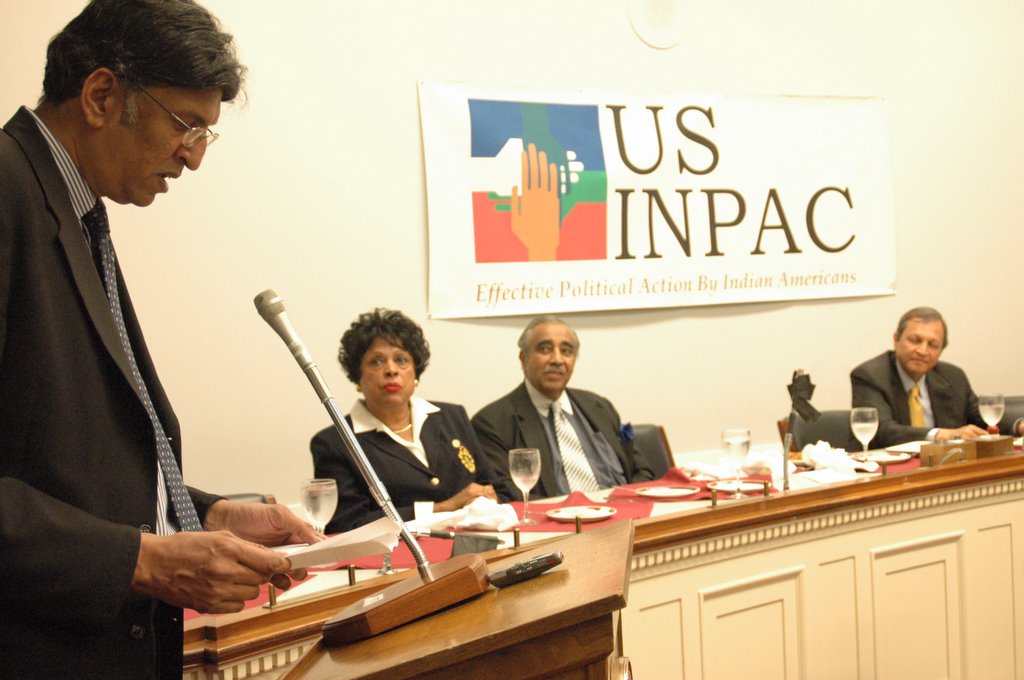
A dinner reception was organized by the United States India Political Action Committe (USINPAC) on November 8, 2005 at the Rayburn Office building, Capitol Hill, to honor India's Ambassador to the US, Ronen Sen.

Several Congressmen turned up to meet and honor Ambassador Sen for his outstanding work in bringing India and the US closer.

Devasish Ray who also is the Media Relations Director of USINPAC read out a letter from Congressman Tom Lantos.

Sunday, October 02, 2005

Water: Safe End to Mehta’s “Elemental Trilogy”


By
Devasish Ray
Washington DC

The US première of Deepa Mehta’s long awaited film, Water screened to a packed Baird Auditorium at the Smithsonian today. The concluding chapter of Mehta’s celebrated “elemental trilogy” has again featured women. This time around it addresses the plight of widows in colonial India when the entire nation is trying to gain freedom through passive resistance led by Mahatma Gandhi.

Yet, Water steers clear from being a political film. Instead it draws a parallel and questions the veracity of the freedom struggle as compared to the totally despicable conditions of ashram life of the widows.

Water centers on a child widow Chuiya who is rudely plucked from her family and sequestered in an ashram inhabited by elderly widows. Here she meets Kalyani (played by Lisa Ray), a breathtakingly beautiful and young widow who is forced to turn sexual favors to rich landlords in return for food. The pot-smoking mistress of the ashram is ruthless and uncaring and enjoys a pretty contended life in a cocoon, she has built for herself.

Kalyani gets another chance to settle down after she meets Narayan (played by John Abraham), the son of a rich landlord and a lawyer who falls in love with her. However, a cruel twist of fate and circumstances crushes Kalyani’s hope at a second shot at marriage, after a law is passed allowing widow remarriage.

The character of Chuiya (brilliantly portrayed by child artist Sarala) who is almost mutinous echoes the frustration and total helplessness of the widows who have come to terms with their way of life. One such character is Shakuntala ( Seema Biswas gives another great performance) a thinking woman, who befriends Chuiya and is successful in helping Chuiya escape from a life of sexual perversion and dominance of the mistress of the ashram.

Water, is perhaps not Deepa Mehta’s best film. The film tries to explore liberalism versus religious traditions set in a backdrop, which confuses the audience. A portion of the film was shot in India and the rest in Sri Lanka, when fundamentalists in India went on a rampage burning Mehta’s set down. The scenes in Sri Lanka look like the backwaters of Kerala and contradict the settings of Varanasi. Mehta’ attention to detail is questionable. In a particular scene Narayan replaces a family photograph with a potrait of Gandhi. The photograph should have been of a much younger Gandhi as the film is set in the year 1938.

Lisa Ray and John Abraham are perhaps not a casting coup. Yet Water should be seen for its content, brilliant photography and a director’s effort in telling a story honestly. It would be interesting to see how the audience in India reacts to this film that is if Water gets past the censors there.

Wednesday, September 28, 2005